The Biofilms Structural Database
A comprehensive, high-resolution structural database of macromolecular proteins, enzymes, and chemical inhibitors involved in bacterial biofilm formation, quorum sensing, extracellular matrix synthesis, and virulence.
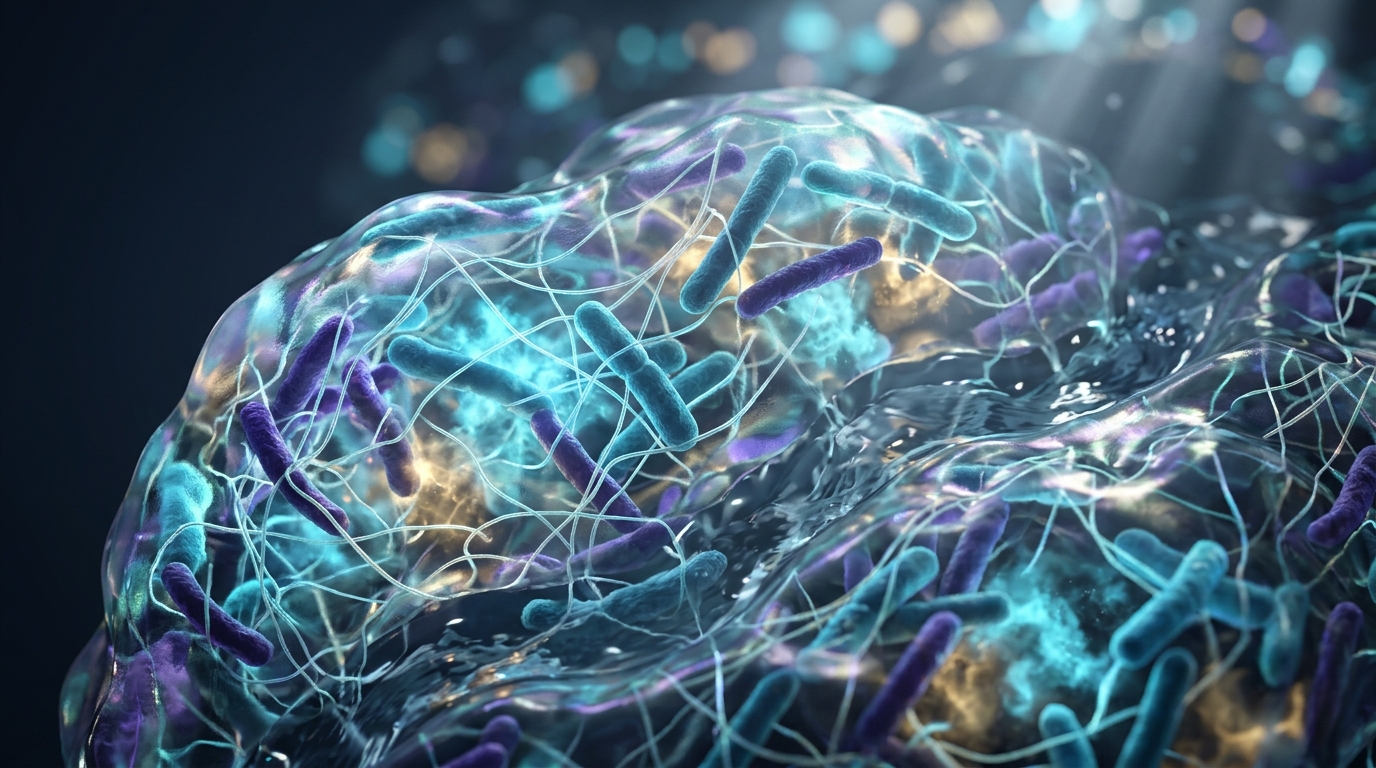
Macromolecular Architecture of a Bacterial Biofilm Community
High-resolution 3D scientific visualization depicting rod-shaped bacilli (such as Pseudomonas aeruginosa and Escherichia coli) embedded within a complex, hydrated Extracellular Polymeric Substance (EPS) hydrogel matrix. Quorum sensing autoinducer signaling gradients (bioluminescent cyan and warm amber particles) diffuse between cells, orchestrating phenotypic transition, antimicrobial tolerance, and collective virulence across biofilm developmental stages.
Bridging Atomic Structure with Rational Antibiofilm Discovery
Grounded in the foundational publication in Trends in Biotechnology (Magalhães et al., 2020), the Biofilms Structural Database (BSD) was established as the first specialized structural bioinformatics repository addressing the global crisis of bacterial biofilm recalcitrance through rational, structure-based non-biocidal targeting.
The Recalcitrance Crisis
Bacterial biofilms account for over 80% of microbial infections in humans (cystic fibrosis lung infections, medical implants, catheters, endocarditis, chronic wounds) and extensive industrial biofouling. Encased in a self-produced Extracellular Polymeric Substances (EPS) matrix, biofilm bacteria exhibit up to 1,000-fold higher tolerance to conventional antibiotics and biocides than planktonic cells.
The Paradigm Shift
Conventional antibiotics exert high selective evolutionary pressure leading to multidrug resistance. Antibiofilm drug discovery bypasses this resistance trap by disarming pathogens without killing them: quenching quorum-sensing (QS) autoinducer communication, enzymatically degrading the protective EPS barrier, inhibiting initial surface adhesion, or triggering active biofilm dispersal.
The Centralized BSD Hub
Prior to BSD, structural information was scattered across generic databases without biofilm lifecycle categorization or ligand binding annotations. BSD provides a benchmark atomic repository uniting 498 high-resolution 3D structures, 168 curated targets, and 131 co-crystallized chemical inhibitors across 47 bacterial species, seamlessly interconnected with UniProt, AlphaFold DB, PDBe-KB, and ChEMBL.
Who Is the Biofilms Structural Database Built For?
Tailored workflows, tools, and cross-referenced resources for every scientific discipline
Computational Chemists & Modelers
In Silico Screening & DynamicsDirect access to curated high-resolution coordinates, AlphaFold DB models, and co-crystallized binding sites for structure-based drug discovery.
- High-resolution crystallographic & cryo-EM coordinates
- Pocket geometry & allosteric binding site analysis
- Clean PDB coordinate sets ready for molecular docking & MD
- Integrated interactive NGL 3D molecular viewer
Medicinal Chemists & Drug Designers
Lead Optimization & SBDDDiscover validated chemical scaffolds, quorum-sensing inhibitors (QSIs), autoinducer mimetics, and enzyme inhibitors with atomic binding poses.
- 131 co-crystallized chemical ligands with 2D & 3D structures
- SMILES, molecular formulas, and LigPlot interaction maps
- Direct cross-links to ChEMBL bioactivities & PubChem
- Structural basis for QSI and EPS disruptor design
Microbiologists & Structural Biologists
Biofilm Mechanisms & PathwaysExplore the atomic machinery governing the 5 stages of the bacterial biofilm developmental lifecycle across 47 Gram-negative and Gram-positive species.
- 168 targets mapped across 5 lifecycle stages
- Sequence lengths, oligomerization states & catalytic co-factors
- Curated UniProt functional dossiers & biological functions
- Dedicated profiles for 47 bacterial species & micrographs
Clinical & Industrial Innovators
Translational Anti-Infective SolutionsAddress chronic device-associated hospital infections (implants, catheters, CF lungs) and combat industrial biofouling and biocorrosion.
- WHO Critical Priority & ESKAPE pathogen target dossiers
- Catheter colonizer & implant infection machinery
- Antifouling enzymatic targets (PelA, AlgL, BdcA)
- Biofilm dispersion triggers for eradication regimens
The Biofilms Structural Database: A Specialized Hub for Rational Antibiofilm Research
Paradigm Biofilm Targets at Atomic Resolution
LasR · Quorum-Sensing Receptor
Master transcriptional activator responding to 3-oxo-C12-HSL autoinducers. Drives virulence and microcolony maturation in cystic fibrosis chronic infections.
Biofilm Developmental Lifecycle & Molecular Milestones
Biological progression from initial attachment to active matrix dispersal
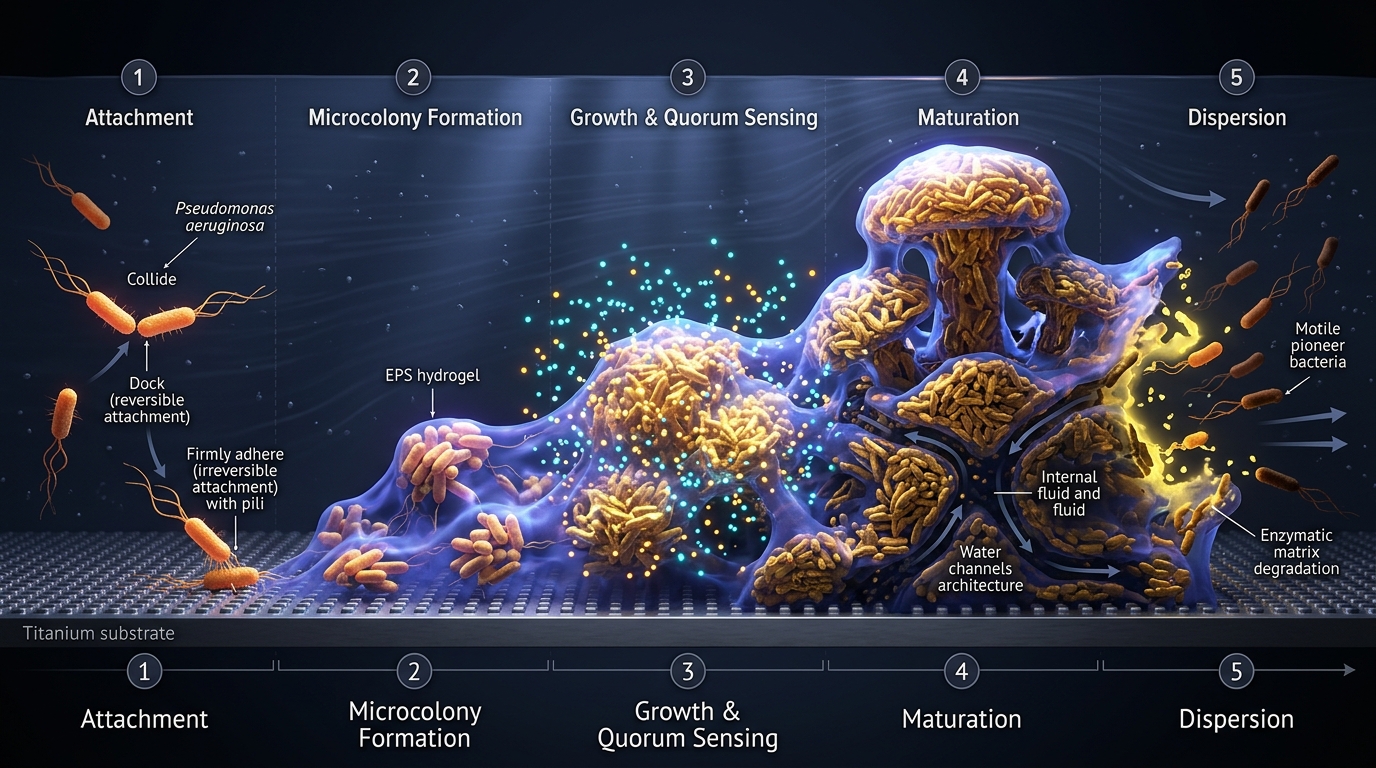
From reversible flagellar and fimbrial tethering on host tissues or biomedical surfaces to high-density mushroom microcolonies protected by hydrated EPS matrix polymers. Quorum-sensing autoinducers (AHL, AI-2, PQS) and c-di-GMP second messengers dictate the lifestyle switch, followed by localized glycoside hydrolase secretion (PelA, AlgL) inducing active cellular dispersal.
Attachment
Reversible & irreversible docking mediated by flagella, fimbriae, and adhesins.
EPS Matrix
Secretion of protective extracellular matrix (alginate, Pel, Psl, cellulose).
Quorum Sensing
Population density-dependent autoinducer communication (AHL, AI-2, PQS).
Signalling
c-di-GMP second messenger network governing the planktonic-to-sessile switch.
Dispersal
Matrix degradation and cell release for colonization of new infection sites.
Key Biological Pathways & Mechanisms
Explore structures grouped by their functional role in the biofilm lifecycle
Quorum Sensing
Intercellular bacterial communication regulating population-density gene expression, autoinducer synthases (LuxI, LasI), and transcriptional receptors (LasR, RhlR).
Explore StructuresEPS Matrix Synthesis
Biosynthesis, modification, and export machinery for extracellular polysaccharides (alginate, Pel, Psl, cellulose) providing structural integrity and antibiotic tolerance.
Explore StructuresAdhesion & Pili Motility
Fimbriae, curli, pili, and surface adhesins responsible for initial reversible and irreversible attachment to biotic and abiotic surfaces.
Explore Structuresc-di-GMP Signalling
Diguanylate cyclases (GGDEF), phosphodiesterases (EAL/HD-GYP), and riboswitches mediating the central lifestyle switch between motility and biofilm sessility.
Explore StructuresTarget Bacterial Pathogens
Organisms with high-resolution crystallographic and NMR structures in the database
Pseudomonas aeruginosa
Gram NegativeClostridioides difficile
Gram PositiveEscherichia coli
Gram NegativeStaphylococcus aureus
Gram PositiveMycobacterium tuberculosis
Gram PositiveBacillus subtilis
Gram PositiveVibrio cholerae
Gram NegativeScientific Direction & Project Leadership


 BIA